An Informational Graphic on Understanding the "Backwards Design" aka "Understanding by Design" model of education.
This video - Royal Society for the Encouragement of Arts, Manufactures and Commerce. (2010). Sir Ken Robinson: Changing education paradigms [Video animation taken from a speech by Sir Ken Robinson] was a required viewing in my Contemporary Issues in Art Education Class. It is brilliant! The content expresses well most of the ideals I have toward education particularly after 5:50 minutes. Considering his take on ADHD, Sir Robinson is very opinionated on this point and it may be a bit harsh, but I certainly think the premise for arts education is accurate. Judge for yourself.
For my History of Art Education class at the University of Florida, I had a bit of fun with graphic novel formats. Both my final Indie project and my Personal Art Ed History ended up getting a great big pen and ink treatment on comic page layout boards. Enjoy.
“For a plan of education is not like the erection of a building, which has to be settled from foundation to roof before a stone is laid. It is rather like the cultivation of a new farm, whose soil has to be tested to see what it will best grow, -corn or roots or wheat: and it will be many seasons before that will display itself.” (Smith, 1873. p. 317)
GREAT MOMENTS IN ART HISTORY PROJECT
for my History of Art Education class at UF
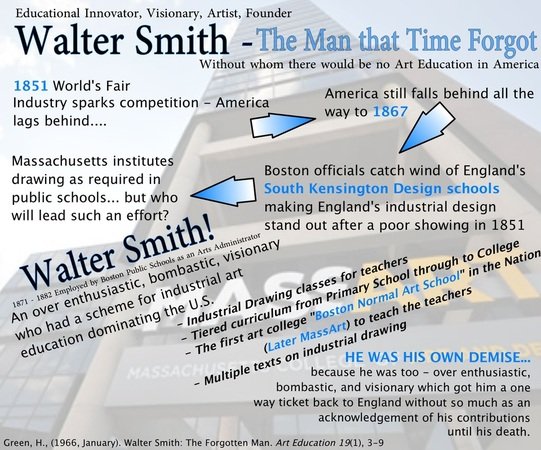
Walter Smith - The Man That Time Forgot
From 1871-1882, Walter Smith served in several capacities for the Boston Public Schools as an Arts Administrator.
During his tenure, he published multiple texts on Industrial Drawing. These texts and a scheme he had plotted to place art education in all grades from primary school through college were Smith's goal for American Art Education.
He achieved portions of his master plan, but ultimately, his personality and conflicts with another person in the Boston political mire caused his downfall here in America.
What he left us with was a need and a drive to place creativity and art making as a portion of all education. Not as an afterthought, but as a necessity to society. We as educators have certainly changed our approach to this goal, but the basic principle I think is still there.
for my History of Art Education class at UF
Walter Smith - The Man That Time Forgot
From 1871-1882, Walter Smith served in several capacities for the Boston Public Schools as an Arts Administrator.
During his tenure, he published multiple texts on Industrial Drawing. These texts and a scheme he had plotted to place art education in all grades from primary school through college were Smith's goal for American Art Education.
He achieved portions of his master plan, but ultimately, his personality and conflicts with another person in the Boston political mire caused his downfall here in America.
What he left us with was a need and a drive to place creativity and art making as a portion of all education. Not as an afterthought, but as a necessity to society. We as educators have certainly changed our approach to this goal, but the basic principle I think is still there.
"Exploring Pollock"
After watching a documentary on Jackson Pollock student artists using similar materials and the techniques of Pollock create their own works in an abbreviated session during class. The experience of movement and immersion helps to improve the student artists' understanding of why and how Pollock developed his abstract expressionist paintings. Following the session, students are asked to discuss what they thought of the art making process. Once dry, the class as a whole displays the work in salon fashion, and again discusses the movement and composition of the works. Understanding of the theories behind Pollock's work and by extension, the work of abstract expressionists, is learned through this Exploration.
After watching a documentary on Jackson Pollock student artists using similar materials and the techniques of Pollock create their own works in an abbreviated session during class. The experience of movement and immersion helps to improve the student artists' understanding of why and how Pollock developed his abstract expressionist paintings. Following the session, students are asked to discuss what they thought of the art making process. Once dry, the class as a whole displays the work in salon fashion, and again discusses the movement and composition of the works. Understanding of the theories behind Pollock's work and by extension, the work of abstract expressionists, is learned through this Exploration.
My Fellow Educators, your students can submit their social commentary in writing, visual art, or video art to this new e-zine: Art Teen E-Zine. Thanks for your support. There are also several resources for your classroom and your students.